Preparing Bottles and Formula: Safe Feeding, Step by Step
Cleaning bottles, sterilizing, the 70°C (158°F) water rule, the right scoop and storing prepared formula: a safe formula guide based on NHS and CDC recommendations.
 HeyMom Editorial Team 🍼 Newborn 4 min read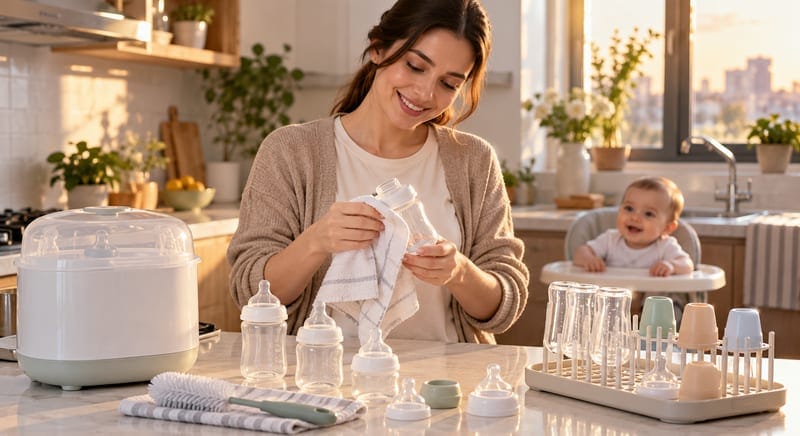
Whether you give only formula or use bottles alongside breast milk, following the same simple steps at every feed protects your baby. Powdered formula is not a sterile product, and small mistakes during preparation can make your baby sick or keep them from getting enough nutrition. This guide brings together recommendations from the UK's National Health Service (NHS) and the US Centers for Disease Control and Prevention (CDC).
Why so much care? According to the CDC, powdered formula is not sterile and may contain germs. One of these is Cronobacter, a bacterium found in the environment. It is rare, but it can cause serious illnesses in babies, such as blood infections (sepsis) and meningitis. Those most at risk are babies younger than 2 months, babies born early and babies with weakened immune systems. The CDC says this bacterium can get onto feeding equipment as well as into powdered formula. So clean hands, a clean surface and a clean bottle matter just as much as the formula itself.
Hands and counter first: Wash your hands well with soap before preparing formula. The CDC recommends cleaning and sanitizing the surface where you will prepare it.
Cleaning bottles: The NHS recommends washing bottles, nipples and other feeding equipment in hot, soapy water as soon as possible after feeds. Use suitable bottle and nipple brushes, then rinse everything in clean, cold running water. Because Cronobacter can also get onto feeding equipment, do not skip this step.
Sterilizing: The NHS recommends sterilizing all feeding equipment, including bottles and nipples, until your baby is at least 12 months old. After washing and rinsing, choose one of these methods:
- Boiling: In a large pot, with everything under the water, for at least 10 minutes.
- Steam sterilizer: Electric or microwave type, following the manufacturer's instructions.
- Cold-water sterilizing solution: Leave items in for at least 30 minutes and replace the solution every 24 hours.
Wash and dry your hands before touching sterilized equipment; you can leave it in the sterilizer until you need it.
The water should be at least 70°C (158°F): According to the NHS, water at 70°C (158°F) or above kills harmful bacteria. Fill the kettle with at least 1 liter (about 1 quart) of fresh water, boil it and leave it to cool for no more than 30 minutes; this way the water stays at 70°C (158°F) or above. Do not reuse water that has been boiled before and cooled. The CDC also recommends, for babies younger than 2 months, born early or with weakened immune systems, boiling the water and waiting about 5 minutes before mixing the formula. The CDC reminds parents to use water from a safe source. The NHS notes that bottled water is not sterile and may contain too much salt or sulfate. If you are not sure the water you use is suitable, talk to your family doctor.
The scoop: not too much, not too little: Put the water in first, then the powder. Measure the water according to the instructions on the formula container. Level each scoop with the straight edge of a clean, dry knife or the leveler provided; do not use more or fewer scoops than the container says. The CDC warns that too much water means the formula will not meet your baby's nutritional needs. Too little water strains your baby's kidneys and digestive system and can lead to dehydration. So never dilute formula or make it stronger.
Cool and test: Put the cap on and shake the bottle. Cool it by holding the bottom half of the bottle under cold running water. Before feeding, drip a few drops onto the inside of your wrist; it should feel warm, not hot. Do not use the microwave: according to the CDC, microwaves heat unevenly and the hot spots that form can burn your baby's mouth and throat.
How long does prepared formula last? The CDC's time limits:
- Use it within 2 hours of preparing, and within 1 hour once the feed has started.
- If you will not start within 2 hours, put the bottle in the fridge right away and use it within 24 hours.
- Throw away any formula your baby does not finish; do not save it for later. Once formula mixes with your baby's saliva, bacteria can grow.
The formula container: Store an opened container with the lid tightly closed in a cool, dry place, not in the fridge. According to the CDC, most formula should be used within 1 month of opening. Never use formula past its expiration date.
When should you see a doctor? The CDC recommends getting medical help right away if a baby younger than 1 year has these symptoms:
- Fever
- Refusing to feed or feeding very little
- Excessive crying
- Looking very weak or low in energy
- Having a seizure
In situations such as a seizure, turning blue or your baby not responding, call your local emergency number without delay.
Dear mom, at first these steps may look like a long list, but within a few days they become second nature: clean hands, a clean bottle, 70°C (158°F) water, the right scoop and throwing away leftover formula. Share these steps with everyone who looks after your baby, too.
Tools that help with this topic
Free and opens right in your browser. Sign in and your records match the ones on your phone.