Pads, Tampons, Menstrual Cups, Period Underwear: Which Is Right for You?
How period products differ, how often to change them, tampon safety, toxic shock syndrome symptoms, menstrual cups and virginity myths.
 HeyMom Editorial Team 🌸 Cycle Health 4 min read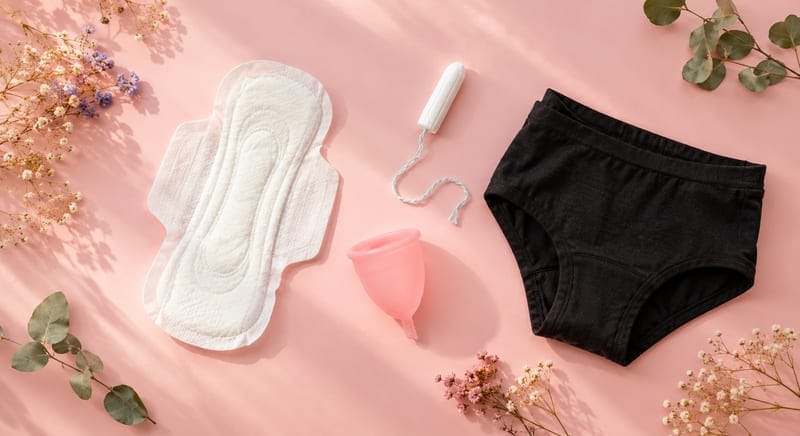
Choosing a period product is completely personal. It depends on your body, your flow, your daily life and what you feel comfortable with. The American College of Obstetricians and Gynecologists (ACOG) notes that these products can be used at different times, and some can be used together. Here is what you need to know about each one.
Pads: A pad sits in your underwear and absorbs blood. According to ACOG, they come in different sizes and thicknesses, with or without wings. Thinner panty liners can be used on light days. Choose your pad based on your body shape, your flow and your comfort. ACOG recommends changing a pad at least every 4-8 hours, or when it is full, wet or uncomfortable. Scented pads can irritate the skin.
Period underwear: This is washable, reusable underwear with an absorbent layer sewn into the fabric. According to ACOG, depending on the product and your flow, you can wear it all day, but sometimes you may need to change it more often. It can also be used with a pad, tampon or cup for extra protection.
Tampons: A tampon is a small product inserted into the vagina that absorbs blood inside the body. There are types with an applicator and types inserted with a finger. According to ACOG, when inserted correctly you cannot feel it, and it has a string at the end for removal. The US Food and Drug Administration (FDA) recommends:
- Change your tampon every 4-8 hours. Never leave a single tampon in for more than 8 hours.
- Choose the lowest absorbency tampon you need. If you can go 8 hours without changing a tampon, the absorbency may be too high.
- Use tampons only during your period.
- Wash your hands before inserting and after removing a tampon.
Toxic shock syndrome (TSS): This is a rare but potentially life-threatening illness. The NHS notes that it can be linked to the use of tampons or menstrual cups. The symptoms listed by the FDA are: a sudden high fever (usually 38.9°C (102°F) or higher), vomiting, diarrhea, fainting or nearly fainting when standing up, dizziness and a rash that looks like a sunburn. According to the NHS, if you suspect this, remove the tampon or cup right away and get medical help. If there is confusion, trouble breathing or skin peeling over large areas, call your local emergency number without delay.
Menstrual cups: A menstrual cup is a flexible cup inserted into the vagina that collects blood. According to ACOG, the cup should be removed and emptied every 8-12 hours. Some cups are disposable, while others can be washed and reused. The NHS recommends washing your hands when using a cup, following the product instructions and not leaving the cup in longer than necessary. For cleaning and storage, follow the instructions for your own cup.
If you have an IUD: Before you start using a menstrual cup or tampons, talk to the doctor who inserted your IUD. Discussing with them how to insert and remove the cup, and how to use it while being careful of the IUD strings, is the safest approach.
Virginity and period products: Many young girls and families worry that tampons or cups will "take away virginity." The World Health Organization (WHO) states clearly that "virginity" is a social, cultural and religious concept with no medical or scientific basis, and that the appearance of the hymen does not reliably show a person's sexual history. Which product you use is entirely your decision. You can choose based on your own comfort and values.
A quick comparison:
- Pad: Used externally, changed at least every 4-8 hours.
- Period underwear: Washable, can be worn all day depending on flow.
- Tampon: Absorbs inside, 8 hours at most, lowest absorbency.
- Menstrual cup: Collects blood, emptied every 8-12 hours.
When to see a doctor? Contact your doctor if:
- You need to change your pad or tampon every 1-2 hours, or your period lasts longer than 7 days
- Period pain keeps you from doing your daily activities
- You have an IUD and are not sure about using a cup or tampons
If you have TSS symptoms such as a sudden high fever, vomiting, dizziness or a rash while using a tampon or cup, remove the product and get medical help right away. If it is serious, call your local emergency number.
Dear woman, the right product is the one that makes you feel comfortable and safe. Do not hesitate to try, switch or use different products on different days. As you get to know your body, you will make the best choice yourself.
Tools that help with this topic
Free and opens right in your browser. Sign in and your records match the ones on your phone.