Baby Bath Time: From the First Bath to a Safe Routine, Step by Step
When should the first bath be, how warm should the water be and how many times a week should you bathe your baby? A step-by-step guide to safe and happy baby baths.
 HeyMom Editorial Team 💧 Newborn 4 min read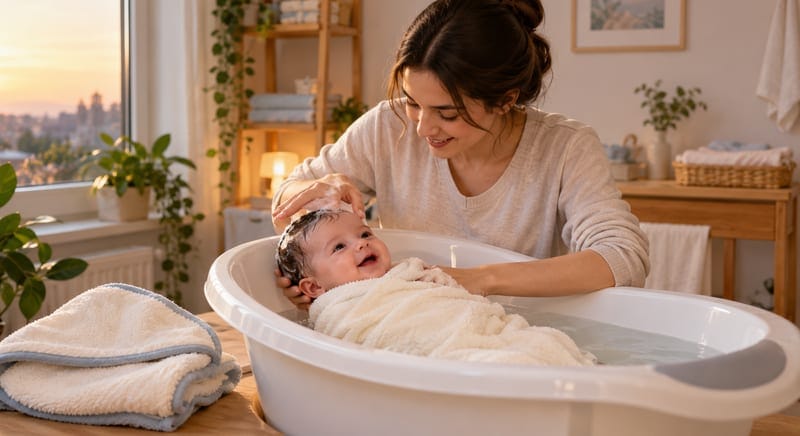
The moment you first lower your baby into the water is both exciting and a little scary. They are tiny, slippery and so precious. But with the right preparation, bath time can become one of the calmest and happiest moments of the day for you both.
No rush for the first bath. According to the World Health Organization's (WHO) 2022 postnatal care recommendations, the first bath of a healthy, full-term newborn should be delayed until at least 24 hours after birth. Turkey's Ministry of Health also notes that washing a baby right after birth can lower their body temperature and do more harm than good.
Sponge baths until the cord falls off. Turkey's Ministry of Health recommends giving the first tub bath at home one day after the cord has dried and fallen off. The American Academy of Pediatrics (AAP) also recommends only sponge baths until the cord falls off. During this time, you can wrap your baby in a towel and wipe them with lukewarm water, starting with the face. Wipe the eyes from the outside in, leave the diaper area until last and clean from front to back.
How often? According to the NHS, you do not need to bathe your baby every day, but if they enjoy it, there is no harm in daily baths. According to the AAP, three baths a week may be enough in the first year. The Turkish Ministry of Health says babies can be bathed every other day or daily in hot weather, but reminds parents that frequent baths dry out the skin, and recommends less frequent baths in winter, at least twice a week.
Preparation: keep everything within reach. According to the Turkish Ministry of Health, the room should always be warmed before the bath. The AAP also recommends setting out the filled tub, the towel and everything else you need before you start. That way you will not have to leave your baby in the middle of the bath to go get something.
Water temperature and depth: According to the Turkish Ministry of Health, bath water should be at body temperature, 35-37°C (95-98.6°F), and the tub should hold about 7-8 cm (about 3 inches) of water. Check the water with a thermometer or the inside of your forearm. The NHS recommends that the water be warm, not hot, and mixed well so there are no hot spots. The AAP also advises that the hottest water from the tap should not go above 49°C (120°F) to prevent burns.
Tub bath, step by step:
- Slide one arm under your baby's head and hold them under the armpit, hold their legs with your other hand and lower them slowly into the water.
- Wash the face and hair first, then clean the body from top to bottom.
- Always keep their head above the water.
- As soon as you lift them out, wrap them in a towel. Gently pat dry the folds, such as the neck, armpits, groin and behind the ears.
The NHS also reminds you to empty the water right after the bath.
Never leave them alone. The NHS and the AAP say the same thing: never leave your baby alone in the tub, not even for a moment. According to the AAP, if you need to answer the phone or the door, take your baby with you. The NHS also stresses not leaving an older sibling in charge of the bath and notes that bath seats are not recommended because of the risk of drowning.
Skin care: simple is best. According to the Turkish Ministry of Health, lukewarm water is enough for bathing in the newborn period; shampoo or soap is not needed. If you do use them, choose pH-neutral products without dyes or fragrance, use very little and rinse well, because soap residue can irritate the skin. If the skin is not dry, no extra cream is needed. If it is dry, you can apply a thin layer of fragrance-free moisturizer.
Do not put cotton swabs in the ears. The NHS says cotton swabs should never be used to clean inside a baby's ear. The Turkish Ministry of Health also describes wiping only the inside and outer edges of the ear during a sponge bath. For the eyes, the NHS recommends using a separate clean piece of cotton wool for each eye.
When should you talk to a doctor? Talk to your pediatrician or family doctor if:
- You notice redness, swelling, discharge or a bad smell around the belly button
- Your baby's skin is very dry, red or cracked despite the bath routine
- The skin becomes irritated after using bath products
If there is an accident in the bath and your baby has trouble breathing, turns blue or becomes unresponsive, call your local emergency number right away.
Dear mom, your hands may shake during the first baths, and that is completely natural. You will get a little more skilled with every bath. Warm water, a cozy towel and your voice make the safest place in the world for your baby.
Tools that help with this topic
Free and opens right in your browser. Sign in and your records match the ones on your phone.