Safe Sleep: How to Reduce the Risk of Sudden Infant Death
Back to sleep, an empty crib, room sharing and swaddling: a safe sleep guide based on AAP and NHS recommendations.
 HeyMom Editorial Team 🌙 Newborn 5 min read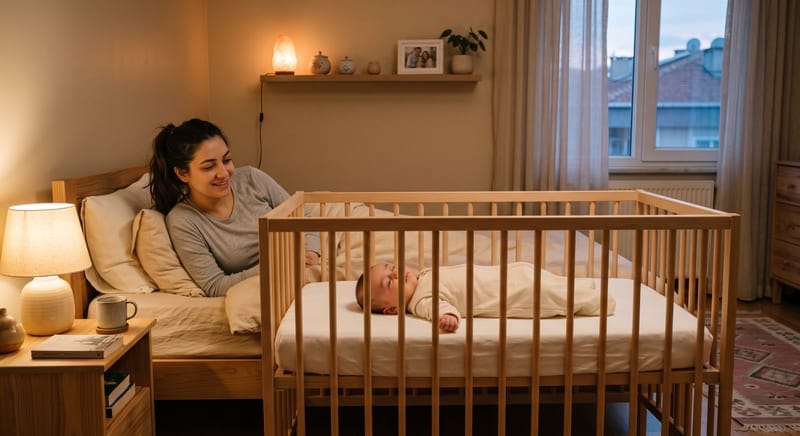
Sudden infant death syndrome (SIDS) is the unexplained death of a seemingly healthy baby during sleep. It is most common in the first 6 months. The cause is not fully known, but a few simple steps in the sleep environment are known to lower the risk significantly. This guide brings together recommendations from the American Academy of Pediatrics (AAP), the NHS and national health authorities. The goal is not to scare you; it is to help you build the same safe habits for every sleep.
1. On the back, for every sleep:
- Night sleep and daytime naps should both be on the back.
- Side sleeping is as risky as tummy sleeping; it is not a "middle ground".
- Putting a baby who is used to back sleeping on their tummy even once raises the risk seriously. That is why everyone who cares for your baby (grandparents, sitters) needs to know the same rule.
- Health authorities also advise putting newborns to sleep on their back and note that tummy sleeping and soft bedding are linked to sudden infant death.
"Won't they choke if they spit up?" This is the most common worry. The AAP and NIH are clear: healthy babies do not choke on spit-up while lying on their back, because the structure of their airway and their gag reflex protect them. The advice is the same for babies with reflux. Raising the head of the crib or propping the baby up with something does not help reflux and is not safe.
2. A firm, flat and empty bed:
- The crib mattress should be firm and flat; it should not sink under the baby's weight.
- The only thing on it should be a fitted sheet that fits the mattress snugly.
- No pillows, duvets, blankets, soft toys or crib bumpers. These increase the risk of suffocation and entrapment.
- Inclined sleep products and weighted sleep sacks or blankets are not safe.
- Surfaces that sag in the middle, like hammocks, are not recommended either; the baby's head can fall forward and narrow the airway. The surface should be as flat as a table.
3. Same room, separate bed:
- The AAP and NHS recommend that the baby sleeps in the same room as the parents for at least the first 6 months, but in their own crib. According to the AAP, this can lower the risk by up to 50%.
- Health authorities also say "same room, separate bed" and stress that the safest place for a baby is their own bed.
- You can place the crib right next to your bed; night feeds get easier too.
Why is sharing a bed risky? An adult bed is soft, has pillows and duvets, and the baby can get trapped or covered. The AAP and other health authorities do not recommend bed sharing. According to the AAP and NHS, the risk is much higher if:
- The baby is under 4 months old
- The baby was born before 37 weeks
- Birth weight was under 2.5 kg (5.5 lb)
- You or your partner smoke
- You have drunk alcohol
- You have taken a medicine or substance that makes you drowsy
- You are very tired
Sofas and armchairs are the most dangerous. Falling asleep on a sofa while holding your baby is one of the highest-risk situations. If you feel sleep coming on during a night feed, put your baby back in the crib.
4. Prevent overheating:
- The NHS recommends a room temperature of 16-20°C (61-68°F).
- Dress your baby in no more than one layer more than you are wearing.
- No hats or caps while sleeping indoors; the head and face should stay uncovered.
- Do not place the crib next to a stove, radiator or heater.
- If the back of the neck or the chest is sweaty, your baby is too warm; remove a layer.
5. Be careful with swaddling:
- Health authorities warn that traditional swaddling with the legs wrapped tightly can lead to hip dislocation.
- The AAP says that if you swaddle, stop as soon as the baby starts trying to roll (usually around 3-4 months, sometimes earlier). A swaddled baby who rolls onto their tummy cannot save themselves.
- Swaddling does not lower the risk of sudden infant death (NIH).
- The NHS recommends a baby sleeping bag instead of swaddling. A sleeping bag leaves room for the legs to move and removes the risk of loose blankets.
6. Other protective steps:
- Breast milk: The AAP considers exclusive breastfeeding for the first 6 months, and continuing alongside solid foods, to be protective.
- Smoke-free environment: Smoking, vaping and secondhand smoke during pregnancy and after birth raise the risk. No one should smoke in the home or the car.
- Vaccines: Keeping up with the vaccine schedule is also among the AAP's protective recommendations.
- Pacifier: The AAP and NHS say offering a pacifier at sleep time may lower the risk. If you are breastfeeding, the AAP suggests waiting until breastfeeding is well established. Some health authorities, however, advise avoiding pacifiers where possible because of the risk of infection and reduced milk supply. It is best to discuss this with your pediatrician for your own baby. Never hang a pacifier around your baby's neck on a string or attach it to their clothing.
Car seats, strollers and bouncers: Sleeping in a car seat during a journey is normal. But once you arrive, take your baby out and lay them on a flat surface. The same applies if they fall asleep in a stroller, swing, bouncer or baby carrier. When using a carrier, the baby's face should be visible, their chin off their chest and their back supported.
Tummy time: Placing your baby on their tummy while they are awake and you are right there is very valuable. It strengthens the neck and shoulder muscles and helps prevent a flat spot on the back of the head. The AAP recommends working up to at least 15-30 minutes a day in total by the time the baby is 7 weeks old; you can start with short sessions. Awake, never asleep.
When your baby starts rolling on their own: Always put them down on their back. If your baby can roll both ways on their own, they can stay in whatever position they choose during sleep. You do not need to get up all night to turn them over. But the crib should still stay empty.
Dear mom, reading this many rules can feel overwhelming, but the summary is short: on the back, empty crib, same room but separate bed, a smoke-free and cool room. Share these four rules with everyone who looks after your baby. If something about your baby's sleep, breathing or color does not feel right, do not hesitate to call your local emergency number or contact your doctor.
Tools that help with this topic
Free and opens right in your browser. Sign in and your records match the ones on your phone.