Infant Car Seats: Rear-Facing Seats, Harnesses and Safe Travel
How long should your baby ride rear-facing, how tight should the harness be and why are puffy coats and sleep a risk? A car seat safety guide based on AAP advice.
 HeyMom Editorial Team 🛡️ Newborn 4 min read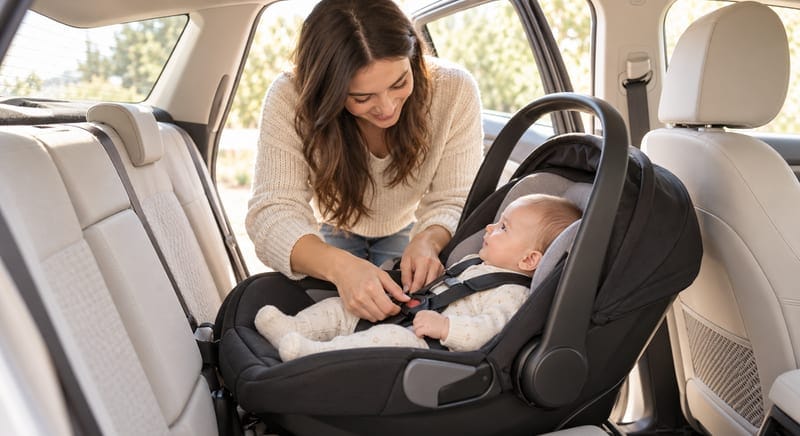
The first ride home from the hospital is the first of countless trips you will take with your baby. The American Academy of Pediatrics (AAP) reminds parents that every year thousands of young children are killed or injured in car crashes, and that using a car seat correctly helps protect them. This guide is based on the AAP's recommendations for families.
Rear-facing for as long as possible: According to the AAP, all babies should ride in a rear-facing seat starting with their very first ride home from the hospital. Babies and toddlers should keep riding rear-facing until they reach the highest weight or height allowed by the seat manufacturer. The AAP notes that most convertible seats allow children to ride rear-facing until age 2 and beyond. When your baby outgrows an infant-only seat, they should move to a convertible seat installed rear-facing. Do not worry about their legs being cramped: the AAP says leg injuries are very rare in rear-facing children.
The front seat and airbags: The AAP stresses that a rear-facing seat should never be placed in a front seat with an active passenger airbag. If the airbag deploys, it hits the back of the car seat, right where your baby's head is, and can cause serious injury or death. According to the AAP, the back seat is the safest place for all children under 13. If the seat can be installed tightly there, the middle of the back seat may be the best spot.
A secure installation: The AAP's installation tips:
- Secure the seat with the vehicle's lower anchors or with a locked vehicle seat belt. Both are equally safe; do not use both together unless the manufacturers allow it.
- If the seat moves more than about 1 inch (2.5 cm) side to side or front to back when you hold it where the belt goes through, it is not tight enough.
- The recline angle should be set so your baby's head does not flop forward. Rear-facing seats have a recline indicator.
- Always read the car seat manual and your vehicle owner's manual.
The harness should be snug: According to the AAP, in a rear-facing seat the shoulder straps should come through the slots at or below your baby's shoulders. The harness is tight enough if you cannot pinch any slack in the strap at the shoulder with your fingers. The chest clip should sit in the middle of the chest, level with the armpits.
No puffy coats: The AAP says puffy clothing such as coats and snowsuits should not be worn under the harness. In a crash, the fluffy padding flattens right away, leaving space under the harness, and a child can slip through the straps and be thrown from the seat. Instead:
- Dress your baby in thin layers.
- After buckling the harness, put a blanket or their coat on backward over them.
- Do not put anything puffy under your baby or between your baby and the harness. The AAP reminds parents that products that did not come with the seat have not been crash tested.
- Keep your baby's face uncovered.
Sleeping in the seat: According to the AAP, your baby can sleep during the ride in a correctly installed car seat. But a car seat is not meant for long stretches of sleep without close supervision, and it is not considered a safe sleep place outside the car. If your baby is asleep in the seat when the trip ends, the AAP recommends moving them onto their back on a firm, flat surface as soon as you can. On long daytime trips, it recommends taking a break every 2-3 hours and, if possible, having an adult sit in the back seat next to the baby. Never try to breastfeed in a moving car.
Never leave your baby alone in the car: According to the AAP, a child's body heats up 3-5 times faster than an adult's, and the inside of a car can heat up by about 11°C (20°F) in 10 minutes. Cracking a window or parking in the shade barely changes the temperature inside. Heatstroke can happen even when it is only about 14°C (57°F) outside. The AAP reminds parents that any loving parent can forget a child and recommends:
- Always check the back seat before you lock the car.
- Put your bag or phone in the back seat.
- Keep your parked car locked and keep the keys out of your child's reach.
- Never leave your baby in the car, not even to grab a coffee.
Secondhand seats: The AAP recommends avoiding secondhand seats whose history you do not know. Do not use a seat that has no manufacture date or model label, is past the manufacturer's recommended use period, has been recalled or has been in a moderate or severe crash.
When to see a doctor, when to call your local emergency number? If your baby was born prematurely, the AAP recommends checking before you leave the hospital that they can sit safely in a semi-reclined position. If you have questions about choosing a seat or about a special health condition your baby has, talk to your pediatrician. If you see a child left alone in a car, call your local emergency number right away. According to the AAP, if the child is unresponsive or in distress, call your local emergency number, get the child out of the car and cool them down with cool water, but do not put them in ice water.
Dear mom, installing a car seat can feel complicated the first time, and that is completely normal. Keep the manual next to you, install it without rushing and check the harness one more time before every trip. Those few minutes give you the peace of mind of knowing your baby is safe on every ride.
Tools that help with this topic
Free and opens right in your browser. Sign in and your records match the ones on your phone.