Cradle Cap (Seborrheic Dermatitis): Harmless, But How Does It Go Away?
Why yellowish, greasy scales appear on your baby's head, how to clean them and which oils not to use, plus cradle cap care and when to see a doctor.
 HeyMom Editorial Team 👶 Newborn 4 min read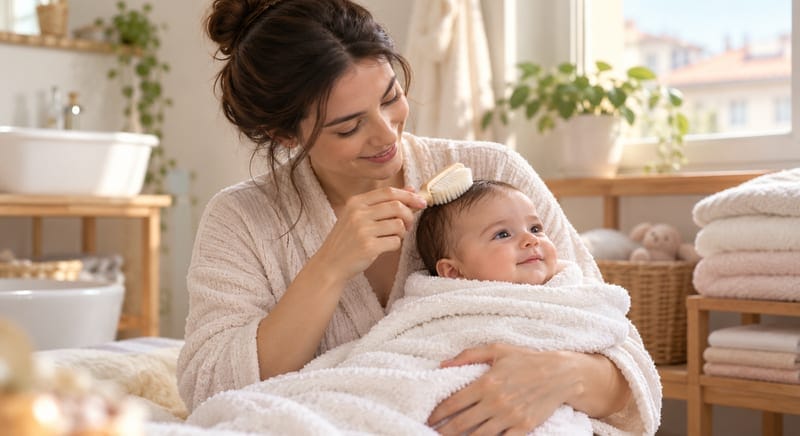
When you notice yellowish, greasy scales on your baby's scalp, your first reaction may be worry. This condition, commonly called cradle cap and known medically as seborrheic dermatitis of the scalp, is actually very common in babies. According to the NHS, it is harmless and usually goes away on its own within a few months. This guide is based on recommendations from the NHS and the American Academy of Pediatrics (AAP).
When does it start, and how common is it? According to the AAP, cradle cap usually starts between 3 weeks and 2 months after birth and is extremely common: 70 percent of 3-month-old babies have it. So what you are seeing on your baby is something many parents go through.
What does it look like? According to the NHS, the main symptom is greasy, scaly patches of skin:
- White or yellow greasy scales on the scalp and face that can crust over and flake off
- Small, dry flakes of skin in the diaper area
The AAP says it can also appear on the face, in the neck folds, behind the ears, in the armpits and in the diaper area. When it appears outside the scalp, it is called seborrheic dermatitis. According to the NHS, cradle cap does not itch or hurt and does not bother your baby.
Why does it happen? According to the NHS, the exact cause is not known. The AAP mentions two possible explanations: a reaction to a yeast commonly found on the skin, or hormones passed from mom making the baby's oil glands overactive. The AAP stresses that cradle cap is not caused by an allergy or an infection, and not by poor hygiene. According to the NHS, it cannot be caught from other babies either.
Washing and a soft brush: The AAP says washing the hair every other day helps most babies. Recommendations from the NHS and the AAP:
- Soften the scales by gently massaging your baby's scalp with a moisturizer or coconut oil.
- Gently brush the scalp with a soft brush or baby comb, then wash it with baby shampoo.
- For stubborn scales, the AAP suggests applying a little mineral oil, coconut oil or petroleum jelly and leaving it on overnight.
- If the scales are on other parts of the body, wash your baby with water and an emollient instead of soap.
According to the NHS, a few strands of hair may come out with the scales. Don't worry; it grows back soon.
Do not pick the crusts: The NHS and the AAP clearly recommend not picking or scratching the crusts, because this increases the risk of infection.
Which products should you avoid? The NHS's warnings:
- Do not use peanut oil; it carries a risk of allergy.
- Do not use olive oil; it may not be suitable for the skin.
- Do not use soap, adult shampoo or products that contain perfume or fragrance.
The AAP recommends talking to your pediatrician before using a medicated shampoo.
If the diaper area is affected: The NHS recommends changing wet or dirty diapers as quickly as possible and applying a barrier cream to protect the skin if the scales are on the bottom or in the diaper area. Your pharmacist can also help you choose a moisturizer suitable for the scalp, a fragrance-free baby shampoo and a barrier cream.
How long does it last? According to the AAP, cradle cap usually goes away on its own within a few weeks or months, and it clears up in most babies by age 1. During this time your baby is usually comfortable; your regular, gentle care is most often enough.
When to see a doctor? According to the NHS and the AAP, see your family doctor or pediatrician if:
- It is not getting better after a few weeks of care
- The cradle cap has spread all over the body
- The crusts bleed or leak fluid
- The affected areas look swollen
- There are pus-filled bumps or a bad smell, or your baby seems uncomfortable
According to the NHS, bleeding, leaking and swelling can be signs of an infection or of another condition such as atopic eczema. According to the AAP, if the cradle cap forms thick crusts, oozes or develops pus-filled bumps, your pediatrician may recommend an antifungal cream or a mild steroid cream. Do not use these kinds of products without talking to a doctor.
Dear mom, cradle cap does not mean anything was missing in your baby's care. With a little oil, a soft brush and patience, these scales will fade over time. What will remain is that sweet, soft baby smell.
Tools that help with this topic
Free and opens right in your browser. Sign in and your records match the ones on your phone.